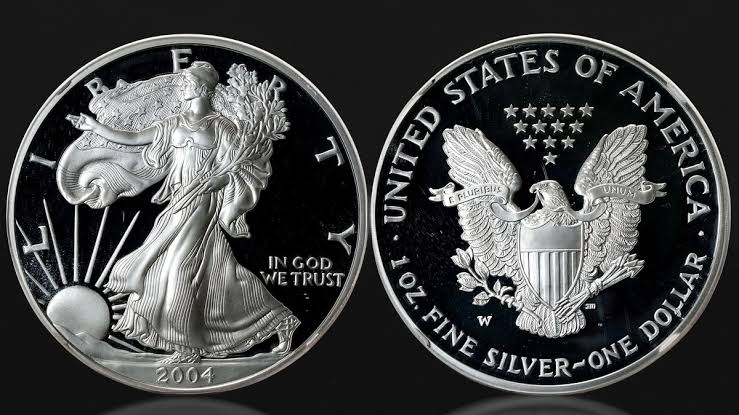
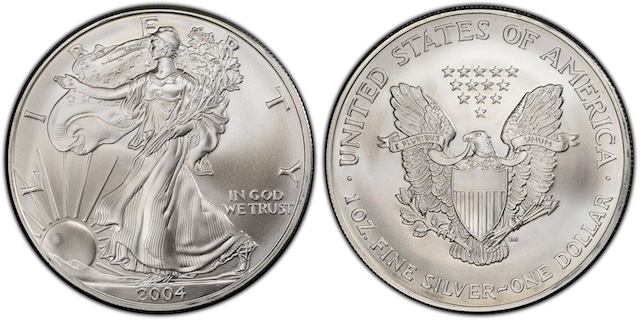
A perfect PCGS MS70 example sold for $1,425 — yet most raw 2004 Silver Eagles trade at barely $2–$5 above silver spot. The difference lies in grade, label, and knowing what to look for. This page gives you every tool you need to find out exactly where your coin lands.
Before diving into individual varieties, this table gives you a fast overview of where your coin's value likely falls based on type and certified grade. For a complete in-depth illustrated identification guide, see this full 2004 silver dollar identification breakdown with step-by-step photos. Values below reflect current market conditions and are ranges — your coin's actual grade determines where it falls.
| Variety / Type | Raw / Ungraded | MS/PR 68 | MS/PR 69 | MS/PR 70 |
|---|---|---|---|---|
| Bullion (No Mint Mark) — MS70 Target ⭐ | Spot + $2–$5 | $35–$55 | $45–$75 | $65–$190+ |
| Bullion (No Mint Mark) — Standard | Spot + $2–$5 | $35–$50 | $45–$70 | $65–$150 |
| 2004-W Proof (Deep Cameo) | $65–$120 w/OGP | $55–$80 | $65–$100 | $150–$300+ |
| Signature Label MS69 (John Mercanti) | N/A — slab only | N/A | $75–$150 | $150–$350+ |
| Struck-Through / Error Coin 🔴 | $100–$500+ | $300–$700 | $500–$1,500+ | Insufficient data |
⭐ = Signature variety (most-searched). 🔴 = Rarest type. Values are market ranges — check PCGS Price Guide for current figures.
📱 CoinKnow lets you snap a photo of your 2004 Silver Eagle and get an instant estimated value in seconds — a coin identifier and value app.
Navigate directly to the tool or guide you need.
Despite the West Point Mint's thorough quality control on American Silver Eagles, genuine error coins do surface for the 2004 issue. Because these are large 40.6mm, one-ounce coins, even minor production anomalies are visually striking — and the collector market pays accordingly. The varieties below are listed in descending value order. Each represents a distinct mint anomaly supported by documented auction sales or grading service populations.
A struck-through error occurs when a foreign object — debris, cloth fiber, a die cap fragment, or grease — is trapped between the die face and the planchet at the moment of striking. The result is a void or raised impression in the coin's surface where metal was prevented from flowing into the die. On Silver Eagles, the mirror-polished fields make these intrusions immediately visible.
To identify a genuine struck-through, look for a defined depression or raised blob with sharp edges in the coin's field or on a design element. The anomaly should show consistent metal displacement consistent with a single strike event. Struck-through grease produces a flat, mushy area rather than a sharp crater.
Silver Eagle struck-through errors command premiums because the series has some of the tightest quality control among U.S. Mint products. Coins that escape the facility with dramatic errors are exceptionally scarce. PCGS-authenticated examples in MS grades regularly attract collector competition at auction.
An off-center strike happens when a planchet fails to seat correctly in the collar before the dies close, causing the design to be stamped off to one side. The struck area retains the complete design image where it landed, while the unprotected side shows a smooth, plain metal crescent. On a 40.6mm silver bullion coin, even a modest 10–15% off-center shift produces a dramatic visual effect.
The key diagnostic feature is a blank crescent of unstruck metal along one edge. The remaining design should be sharp and fully struck — if the design is mushy throughout, the coin may instead be a broad strike or weak strike rather than a true off-center. On 2004 Silver Eagles, the Walking Liberty obverse shows a distinctive partial silhouette when offset.
Collector demand for off-center Silver Eagles is high because they combine the prestige of the series with genuine rarity. The more dramatic the offset, the higher the premium — examples shifted 50% or more, where the date "2004" is still clearly readable, rank as the most desirable. PCGS and NGC slabbed off-center examples have sold for several hundred dollars at specialist auctions.
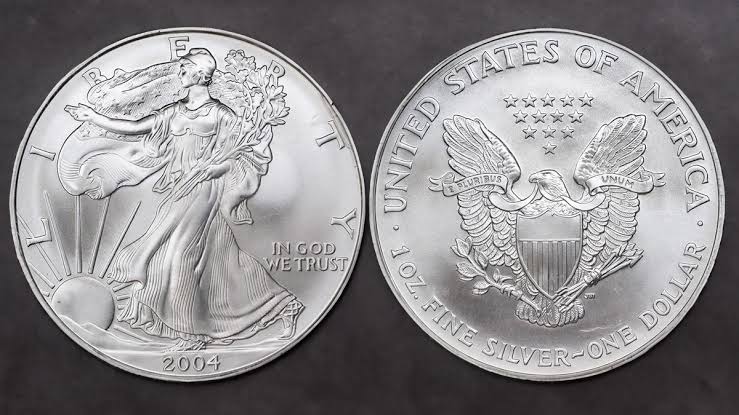
Milk spots are not a mint error in the traditional sense but represent one of the most debated post-mint phenomena affecting American Silver Eagles. They appear as white, cloudy circular patches on the mirror fields of bullion or proof coins. The current scientific consensus holds that milk spots form when microscopic residue from the coin-blank annealing and washing process reacts with environmental moisture over time, creating silver chloride or sulfide deposits.
Severe milk spotting is identifiable as distinct, raised or flat white patches that cannot be removed without damaging the coin's surface. Under a loupe they appear as matte white islands on the otherwise mirror-bright field. Unlike die polish lines or contact marks, they have no directional orientation. The 2004 issue is documented as having a higher-than-average incidence of milk spotting compared to later dates.
For collectors, a heavily spotted 2004 Silver Eagle is a significant grade-breaker. Both PCGS and NGC consider severe milk spotting when assigning Mint State grades, and spotted coins consistently grade lower — often MS63 to MS65 — than their unspotted counterparts. Collectors building high-grade sets specifically seek spot-free examples. Lightly spotted coins are common; severely spotted examples actually have some novelty value in the error-coin market.
A double strike occurs when a coin receives two distinct impacts from the dies rather than the standard single strike. The second strike may be aligned with the first (creating an in-collar double), or offset (producing a dramatic overlapping ghost image). On American Silver Eagles, the collar-retained double strike produces a somewhat thicker than normal planchet with design elements showing doubled depth and a slightly mushy appearance.
The out-of-collar double strike is visually unmistakable: you can see two distinct, fully three-dimensional impressions of Lady Liberty or the heraldic eagle overlapping each other. The second strike often rotates slightly relative to the first, creating a characteristic "fan" of overlapping design elements. The reeded edge may show distortion or a second set of reeds from the out-of-collar event.
Because Silver Eagles are closely inspected during packaging at the West Point Mint, double strikes that escape quality control represent a genuine production oversight. Authenticated examples are highly coveted by error-coin specialists. NGC and PCGS both examine these extensively before encapsulation and assign premium grades to well-struck, clearly documented double-strike specimens.
Use the free calculator to get an estimated value based on your specific mint, condition, and error — takes about 30 seconds.
| Issue Type | Mint | Mint Mark | Mintage | Notes |
|---|---|---|---|---|
| Bullion (Regular Strike) | West Point | None | 8,882,754 | Sold through authorized bullion dealers; +4% vs 2003 |
| Proof (2004-W) | West Point | W | 850,000 | Sold directly by U.S. Mint to collectors; DCAM finish |
| Total 2004 Production | 9,732,754 | |||
Noticeable contact marks, bag marks, or heavy milk spotting on the fields. Luster may be broken in places. Full strike but surfaces show clear evidence of handling. Raw coins stored improperly fall here.
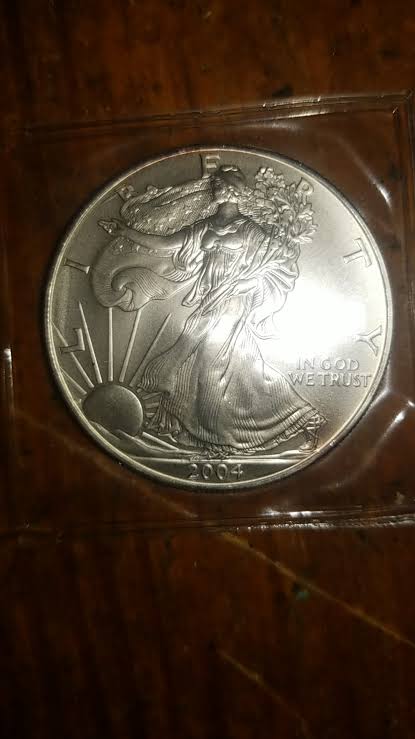
Moderate scattered contact marks visible without magnification. Luster is present but interrupted. Strike is full and sharp. A typical raw 2004 Silver Eagle pulled from a mixed batch often grades in this tier.
Only minor marks visible under magnification. Strong, complete luster. MS69 — the most common certified grade — has only a tiny, nearly imperceptible flaw. Prior to 2014, PCGS reported nearly 9 MS69s for every MS70 submitted.
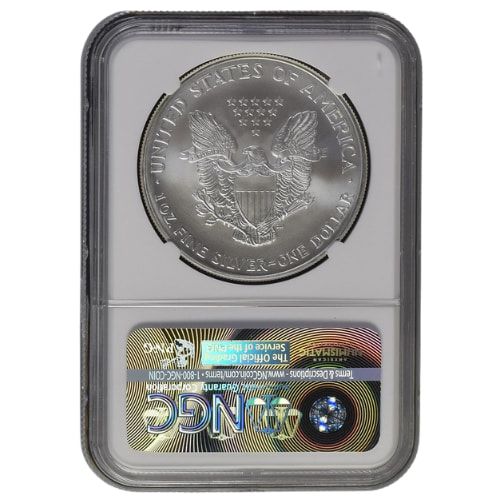
Absolutely no post-production imperfections visible at 5× magnification. Mirror-bright fields, fully struck devices, zero marks or spots. The grade commanding the highest premium — $1,425 in an early auction, with recent MS70 sales ranging $65–$190+.
🔎 CoinKnow — snap a photo to cross-check your condition assessment against certified comparable examples — a coin identifier and value app.
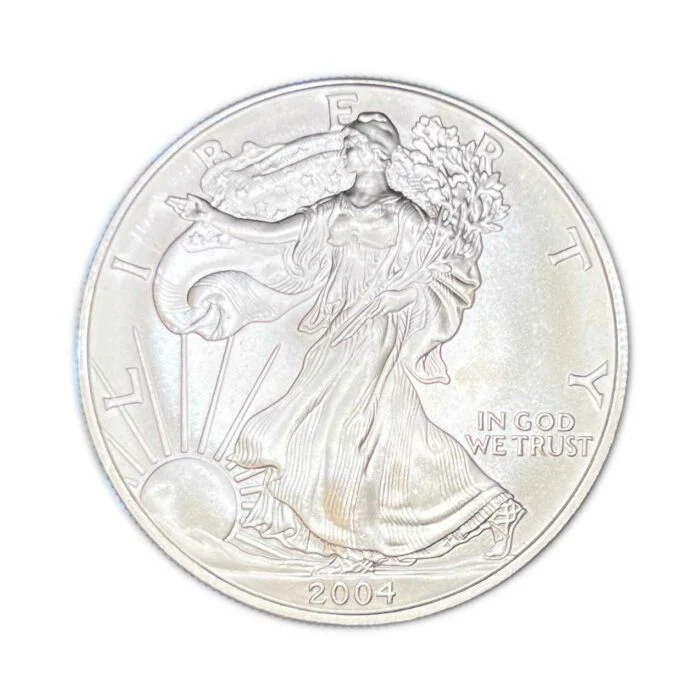
MS70 is the single most searched grade for 2004 Silver Eagles because it carries the largest premium. Use this quick visual comparison and 4-point checklist to assess whether your coin has a realistic shot at the perfect grade before paying grading fees.
The MS70 checker tells you the grade potential — the calculator below turns that grade into a dollar estimate based on current market data for your specific coin type.
Select your coin's mint mark, condition, and any errors to get an instant estimated value. Results reflect current market ranges based on PCGS and eBay auction data.
If you're not sure about your coin's mint mark or condition yet, a free 2004 Silver Dollar Coin Value Checker online tool lets you upload a photo and get an AI-powered estimate without needing to know the details first.
Not sure about the grade or errors? Describe what you see and our analyzer will provide a personalized read on your coin.
The right venue depends on whether you have a raw bullion coin, a certified MS69/70 example, or a genuine error piece. Here's what each option gets you.
Best for: MS70 signature label coins, confirmed error coins, high-value slabs.
Why: Heritage reaches the largest pool of serious American Silver Eagle set builders and error collectors. Their specialist numismatists ensure accurate attribution and competitive bidding. Commission fees apply but the realized premium typically justifies them for coins worth $200+.
Best for: All grades — raw, MS69, MS70, proofs.
Why: The broadest buyer pool for 2004 Silver Eagles. Check recently completed 2004 silver dollar sold prices and listings before setting your asking price — comps matter. Certified coins in PCGS/NGC slabs sell faster and at higher prices than raw examples. Use "Buy It Now" with Best Offer for certified coins; auction format for unique errors.
Best for: Raw bullion coins where speed matters more than maximum price.
Why: A coin dealer pays close to spot for ungraded 2004 Silver Eagles — typically spot price to spot + $2. Fast and simple, no fees, no waiting. For certified MS70 or error coins, dealers will offer below market value since they need margin; consider other venues for premium pieces.
Best for: MS69 slabs, proofs with OGP, and coins in the $50–$200 range.
Why: The r/CoinSales and r/Silverbugs subreddits are active markets with knowledgeable buyers who pay fair prices for certified Silver Eagles. No fees beyond PayPal. Requires good photos, honest description, and a brief selling history to build trust. Lower overhead than eBay makes it attractive for mid-tier coins.
A raw, ungraded 2004 American Silver Eagle is worth approximately silver spot price plus a small dealer premium of $2–$5. At current silver prices around $30/oz, that puts most raw examples in the $32–$40 range. Certified MS69 examples typically trade for $45–$75, while perfect MS70 coins command $65–$190 or more depending on label type. The all-time PCGS auction record for this date is $1,425 for an MS70 sold in 2011.
MS70 is a perfect coin with absolutely no post-production imperfections visible under 5× magnification. Look for flawless luster across the entire field, a fully sharp strike with crisp detail on Liberty's gown and hand, and zero contact marks, milk spots, or hairlines. The fields (background areas) should be mirror-bright. Even a single microscopic mark drops a coin to MS69. Only a third-party grader like PCGS or NGC can officially award the MS70 grade.
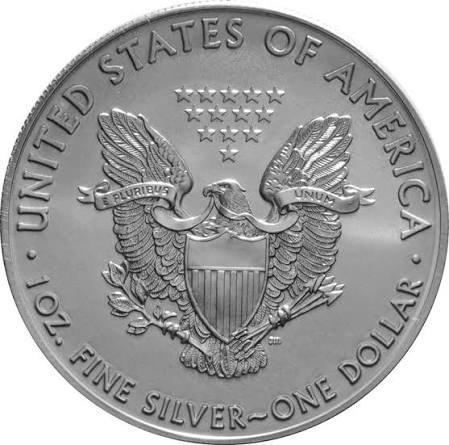
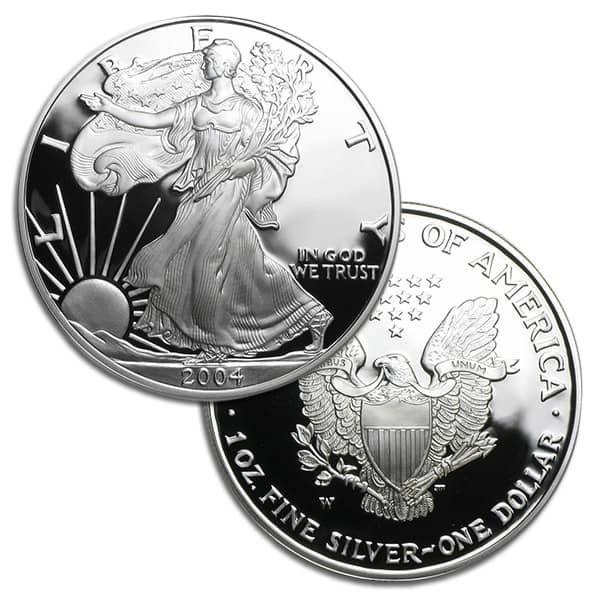
Regular bullion 2004 American Silver Eagles have no mint mark even though they were physically struck at the West Point Mint. Only the proof version, produced at West Point for collectors, carries a 'W' mint mark on the reverse below the eagle. If your coin has a 'W' mint mark it is the proof issue, which had a much smaller mintage of 850,000 and typically trades at a premium over the bullion version.
The 2004 American Silver Eagle bullion issue had a mintage of 8,882,754 coins, representing a modest 4% increase from 2003. These were all struck at the West Point Mint but carry no mint mark. Additionally, 850,000 proof versions (2004-W) were struck for numismatic sales. Both figures are confirmed by the U.S. Mint and PCGS CoinFacts.
Earlier American Silver Eagles like the 2004 issue are noticeably harder to find in perfect MS70 compared to modern issues. Greysheet and CoinWeek note that pre-2008 silver eagles simply aren't readily available in MS70 the way newer coins are. PCGS reports over 4,300 MS70 examples graded to date, but many were specially submitted from mint-fresh storage. Raw coins pulled from tubes today are likely to show handling marks and grade MS69 at best.
The 2004-W Proof Silver Eagle features deep-cameo contrast between frosted devices and mirror-polished fields. Ungraded examples with original government packaging typically sell for $65–$120. Certified PR69 Deep Cameo examples trade around $65–$100, while perfect PR70 DCAM coins can bring $150–$300 or more, particularly with desirable labels. The proof mintage of 850,000 makes it more collectible than the high-mintage bullion version.
The most notable error varieties on 2004 American Silver Eagles include struck-through errors (where a foreign object leaves an impression in the coin's surface), off-center strikes, and die-cap strikes. Because Silver Eagles are large, high-profile coins with thorough quality control at the West Point Mint, mint errors are genuinely rare and can command significant premiums. A dramatic off-center or struck-through error in uncirculated grade can be worth several hundred to several thousand dollars.
In 2004, PCGS partnered with celebrities and public figures to produce signature label coins where notable individuals signed the label insert on graded slabs. Signers included Lance Armstrong (812 MS69 coins), Jessica Lynch (601 MS69 coins), General Tommy Franks, reverse designer John Mercanti, astronaut Kathryn Sullivan, and baseball Hall of Famer Paul Molitor. These signature labels add collectible value beyond the coin's grade, with demand varying by the signer's current fame.
Store raw 2004 Silver Eagles in airtight capsules or original mint tubes away from humidity, sulfur compounds, and PVC-containing plastics. Milk spotting — a common silver eagle affliction — occurs when microscopic residue from the minting process reacts with environmental moisture. Never clean a silver eagle with any abrasive or chemical. For coins you hope to grade MS69 or MS70, wear cotton gloves when handling, hold only by the edge, and submit in protective packaging.
The 2004 American Silver Eagle holds its value as a one-ounce silver bullion coin, giving it a built-in floor tied to the silver spot price. For numismatic upside, MS70 certified examples still command a premium over spot, though that premium has declined from peak levels around 2011–2014. Signature label examples with desirable signers retain collector interest. For pure silver investment, raw coins are efficient; for numismatic appreciation, MS70 with original labels offers the best premium potential.
Use the free calculator — it takes about 30 seconds and gives you a real market estimate based on mint, grade, and errors.
Calculate My Coin's Value Now →